
Review · ST MARK'S BASILICA GONDOLA RIDES
Venice: St. Mark’s Walking Tour & Gondola Traghetto Crossing
Venice’s best short tours do not need a long gondola ride. This one gives you something more local: a gondola traghetto crossing across the Grand Canal, the practical ferry Venetians use where no bridge is available. You also get a brief live introduction, then explore on your own with audio commentary.
I like the easy loop from St. Mark’s Square to Dorsoduro, and I like the freedom to stop for photos, coffee, or a closer look at a church. The price is low for two hours of sightseeing, but you should know that the live guiding is limited to about 15 minutes. The rest depends on your phone, headphones, and your ability to follow the route.
Key points to know
- A real Venetian crossing: The traghetto is a working local service, not a private sightseeing gondola.
- Thirty-six stops: The route covers major monuments, political history, art, trade, and everyday city life.
- Only a short live introduction: After the English welcome, the audio guide takes over.
- Nine audio languages: Choose English, French, Italian, Spanish, German, Portuguese, Russian, Chinese, or Japanese.
- Good family format: Children can enjoy the ferry and flexible pace, though bridges and uneven paving make the route unsuitable for wheelchairs.
- Bring your own gear: You need comfortable shoes, headphones, and a charged smartphone.
Starting at Campo San Zaccaria
You begin at the partner office at Campo San Zaccaria, near St. Mark’s Square. Arrive five to ten minutes early so you have time to check in, receive the route details, and sort out the audio guide before heading out.
The host gives you an introduction of roughly 15 minutes in English. This is the part where you can ask a question, get your bearings, and learn how Venice grew around water, trade, religion, and political power. The live portion is short, so think of it as an orientation rather than a full walking tour.
That distinction matters. If you want a guide beside you for the whole route, this is not the right format. If you prefer to listen for a while, stop for a photo, and then continue without holding up a group, the setup is much more appealing.
The welcome is also the point where you should confirm how the audio content works on your smartphone. Use headphones if you have them, and start with a charged phone. Venice is a poor place to discover that your battery is nearly empty.
More St Mark's Basilica Gondola Rides in Venice:
- Venice In a Day: St Mark’s, Doges Palace Gondola Ride & City Tour
★ 5.0 · 3,588 reviews - Venice’s Best: Basilica, Doge’s Palace, Gondola & History Gallery
★ 4.5 · 2,478 reviews - Best Of Venice: Saint Mark’s Basilica, Doges Palace with Guide and Gondola Ride
★ 4.5 · 800 reviews
St. Mark’s Square and the machinery of power
The route moves toward St. Mark’s Square, Venice’s grand public stage. Here you hear about the square’s role as the political and symbolic center of the old republic, not just a scenic place lined with cafés.
The audio route covers St. Mark’s Basilica, with its glittering mosaics and strong Eastern influences. You do not enter the basilica as part of this experience, so think of the stop as an explanation from outside. That still gives you useful context before a separate visit, especially if you want to understand why Venice’s church looks so different from many Italian cathedrals.
Nearby, the Clock Tower explains how timekeeping, commerce, and public life came together in the square. The old Ridotto near Caffè Lavena brings a different story: gambling, Carnival society, and the social habits of Venice’s wealthy residents.
You then pass the Procuratie Vecchie and Procuratie Nuove, the long buildings that frame the square. Their arcades can look like a continuous wall of elegant façades, but the commentary points you toward their institutional role and the way the city changed over time.
The Napoleonic Wing and Museo Correr add another turn in the story. Venice was not frozen in postcard form. The republic fell, foreign powers arrived, and the city had to reshape its civic identity. That political shift gives the square more weight than its polished appearance suggests.
Caffè Florian, the Campanile, and ceremonial Venice
Caffè Florian is one of the route’s more atmospheric stops. It represents the old café culture of Venice, where artists, political figures, and visitors mixed in a setting designed for display as much as refreshment.
You also hear about the Campanile and its Loggia. The bell tower is one of the easiest landmarks to use for orientation, especially when narrow lanes make the city feel like a maze. Its role was not only practical. It helped create the spectacle of St. Mark’s Square.
The Doge’s Palace receives more serious attention. Look for the red columns and listen for the connection between architecture, justice, and political authority. The nearby Porta della Carta and the figures known as the Tetrarchs add another layer of law and state ceremony.
This is a dense opening section. Thirty-six points in two hours means you will not spend long at every sight. I suggest pausing the audio when you want to inspect a detail, then restarting only when you are ready. The experience works best when you treat the route as a framework, not a race.
The waterfront, prisons, and the Grand Canal crossing
The route continues to the Biblioteca Marciana and the Zecca, linking knowledge with money. From there, you reach the Columns of St. Mark and St. Theodore, a place associated with public justice and executions. It is a sharp reminder that Venice’s handsome waterfront also served the machinery of the state.
The view across St. Mark’s Basin gives you a chance to look outward. Venice faces the sea, and that maritime position shaped its trade, diplomacy, and wealth. The audio commentary helps connect the water in front of you with the city’s larger story.
The prisons and Bridge of Sighs bring in crime, punishment, and legend. The bridge is famous for its name, but the nearby prison complex makes the story more concrete. You are looking at a system of justice, not only a romantic photo stop.
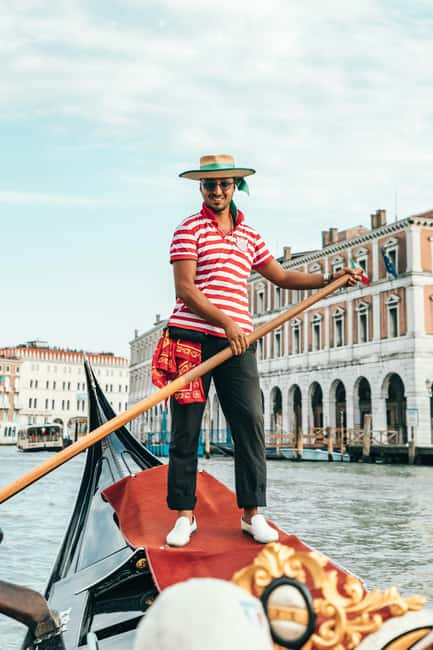
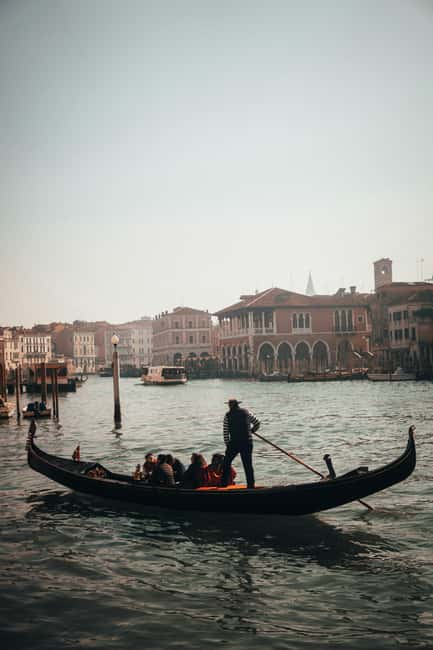
The traditional traghetto crossing comes midway through the walk. You pay the gondolier directly, usually €2 per person. The fee cannot be prepaid because this is a locally regulated service. The crossing is generally available during operating hours, usually from 10:00 in the morning until 5:00 in the afternoon.
This is not the same as booking a private gondola ride. The traghetto is a short public crossing, and its value is the ordinary Venetian experience. You cross the Grand Canal by boat, usually alongside other passengers, rather than taking a long decorated ride through smaller canals.
Check the timing before you set out. If you begin late or move slowly, you do not want to reach the crossing after service has ended. The route is flexible, but the ferry has its own schedule.
More Gondola Rides with a Walking Tour in Venice:
- Venice Walking Tour and Gondola Ride
★ 3.5 · 3,630 reviews - Venice: City Center Walking Tour & Iconic Gondola Ride
★ 4.3 · 500 reviews - Venice: Walking Tour and Shared Gondola Ride
★ 4.1 · 466 reviews - Venice Walking Tour and Gondola Ride Combo
★ 4.4 · 266 reviews
From the Royal Gardens to San Moisè
After the waterfront, the walk passes the Royal Gardens, tied to Napoleon and the political symbolism of the area. This section helps you see how each ruling power left marks on central Venice.
The Hotel Monaco and the former Ridotto of San Moisè introduce another side of Venetian public life. The Ridotto is associated with the first public casino in Europe, so the story shifts from government and religion to entertainment, money, and social rules.
The Campo and Church of San Moisè continue that theme of public theatre. Baroque decoration, symbolic power, and the drama of the city all meet here. You may find this part especially useful if you have already seen the obvious sights and want a better sense of how Venice worked beyond the main square.
The route remains focused on outside views. This is a sightseeing walk with commentary, not an admissions package for the churches, museums, or palaces along the way. If you want to go inside places such as the Doge’s Palace, St. Mark’s Basilica, or the Peggy Guggenheim Collection, plan those visits separately.
Dorsoduro and Venice’s artistic side
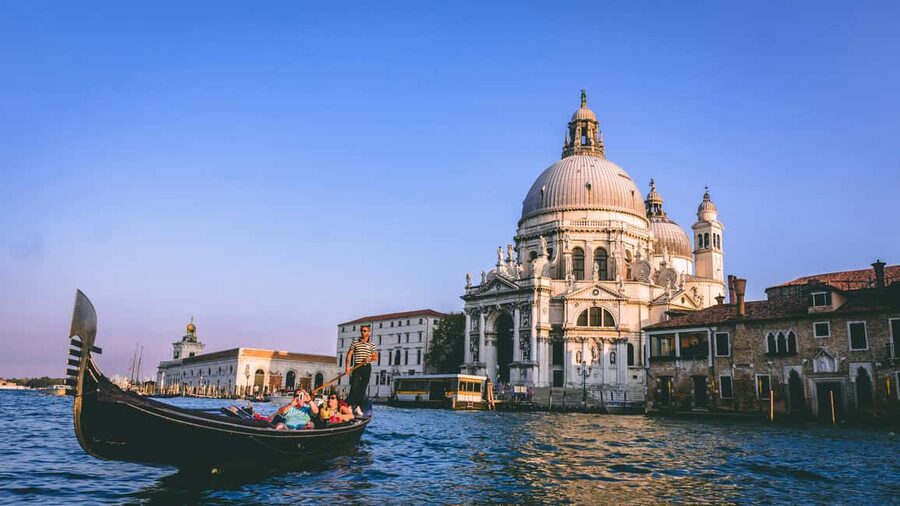
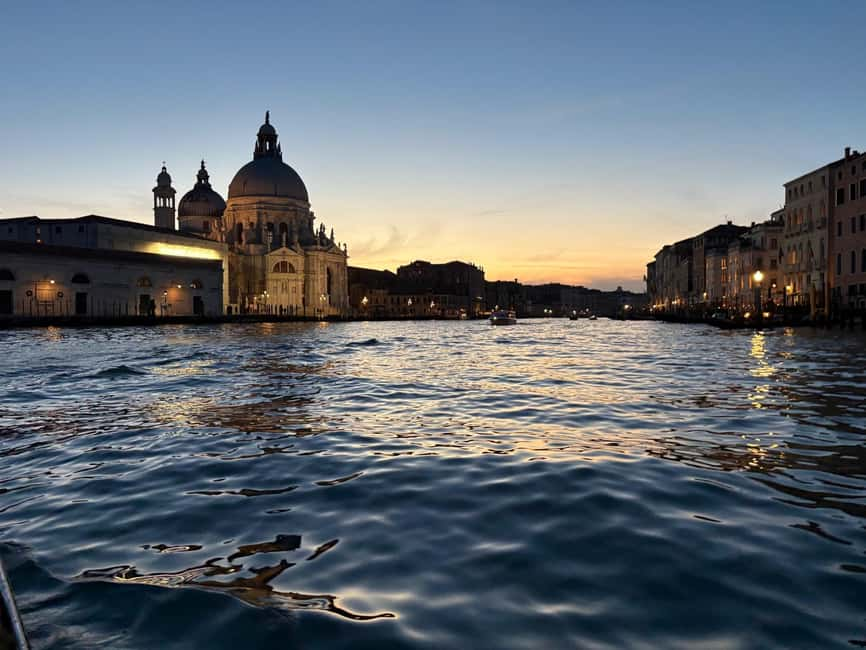
The crossing leads you toward Dorsoduro, a district with a different feel from the formal center around St. Mark’s Square. The walk takes in Santa Maria della Salute, built after a plague as a votive church. Its broad dome and position beside the water make it one of Venice’s most recognizable views.
At Dogana da Mar, trade and modern art meet. The old customs area faces the water, while contemporary exhibitions have given the building a new cultural role. This is one of the route’s better examples of Venice as a living city rather than a preserved museum.
Ca’ Dario brings a darker note. The palace is tied to stories of unlucky owners and strange destinies. Treat these tales as part of Venice’s storytelling culture, not as a reason to expect a supernatural event.
The Peggy Guggenheim Collection adds modern art and a strong individual vision. Again, the tour points you toward the museum but does not include entry. If modern art is important to you, you may want to reserve separate time here.
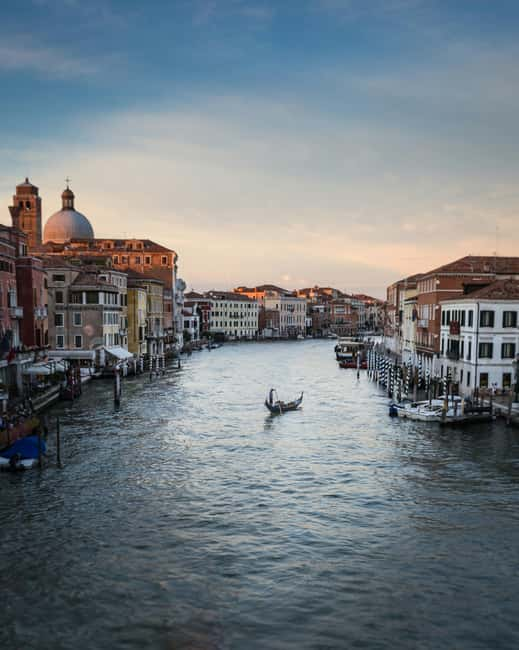
You also pass Palazzo Cini and the Gallerie dell’Accademia, both important for Venetian art. The Accademia Bridge gives you one of the classic views along the Grand Canal and a useful sense of how the waterway organizes the city. The commentary connects the bridge with the canal’s role as Venice’s main urban corridor.
La Fenice and the walk back to St. Mark’s
Teatro La Fenice is a highlight for anyone interested in music, fire, and rebuilding. Its story of destruction and rebirth reflects Venice itself: elegant, vulnerable, and repeatedly forced to adapt.
Calle Larga XXII Marzo brings the route through a more polished shopping street. Its luxury shops can make the area feel modern, but the audio adds the political memory of the 1848 revolution.
By the end, you have moved through government buildings, churches, prisons, cafés, museums, luxury streets, and working water transport. The loop returns to St. Mark’s Square, so you finish where you began rather than needing to find a new part of town.
What the €14 price really buys
At $14 per person, the experience is inexpensive by Venice tour standards. You receive the short hosted introduction, the audio route in nine languages, assistance at the start, ongoing support from the provider during your stay, and a small gondola-themed souvenir.
You should add about €2 per person for the traghetto. That remains a modest total, especially for families or couples who want an organized route without paying for a private guide.
The value depends on what you expect from the word tour. You are paying for orientation, audio content, route planning, and the chance to use a real local ferry. You are not paying for two hours of continuous personal guiding.
That difference explains why the experience can feel excellent for one person and disappointing for another. The audio route is simple to use when the opening instructions are clear. But if the check-in feels rushed, you may feel that you were handed a leaflet and left to manage the rest alone.
Recent feedback is notably uneven. Several bookings praised the warm start, clear explanation, easy audio guide, and strong value, while other customers reported no organized tour, no crossing, or no souvenir. I would confirm the meeting instructions carefully and ask the host to demonstrate the audio setup before leaving the office.
Who will enjoy this walking loop?
I would choose this for a first visit when you want a broad introduction without committing to a long private tour. It also suits repeat visitors who know the main square but want a route toward Dorsoduro, modern art, and the Grand Canal.
Families may like the flexible pace. Children get a boat crossing, open-air sights, and short bursts of audio instead of a continuous lecture. You still need to watch your timing and footwear, since Venice includes bridges, steps, and uneven surfaces.
The tour works well for independent visitors who enjoy choosing their own stops. It is less suitable if you want detailed answers at every monument, a tightly supervised group, or full wheelchair access. The uneven surfaces and bridges make it unsuitable for wheelchairs.
The audio languages are a real advantage for mixed-language groups. English, French, Italian, Spanish, German, Portuguese, Russian, Chinese, and Japanese are available. The live welcome is in English, although hosts or greeters may also speak several other listed languages.
Practical advice before you set out
Wear shoes you can walk in for two hours. Bring headphones and charge your phone fully. If you use mobile data abroad, check that your audio content is ready before leaving the office.
Start early enough to reach the traghetto during its usual operating period. A slow pace is part of the appeal, but a late start can create a timing problem.
Keep the €2 ferry fee in small cash if possible. The payment is made directly to the gondolier, not to the tour office.
Do not schedule an important timed museum visit immediately after the tour. The advertised duration is about two hours, but your pace, pauses, and ferry timing can affect the finish.
Should you book this Venice experience?
I would book it if you want a low-cost introduction, a self-guided route with good historical range, and a genuine short crossing on the Grand Canal. The best parts are the freedom to pause, the move from St. Mark’s into Dorsoduro, and the chance to use transport that belongs to daily Venetian life.
I would skip it if your priority is a continuously guided walking tour or a private gondola ride. The limited live introduction and uneven reports about organization mean you should arrive with realistic expectations.
For the price, it can be a smart first-day activity, especially if you confirm the audio setup, plan the traghetto before 5:00 PM, and treat the route as a flexible guide rather than a fully escorted tour.
FAQ
Where does the tour start and finish?
You check in at the partner office at Campo San Zaccaria 4683g, five to ten minutes before the start. The walking loop ends in St. Mark’s Square.
How long does the experience last?
The full experience lasts approximately two hours, including the short guided introduction, audio-supported walk, and traghetto crossing.
Is the gondola crossing included in the price?
The crossing itself is not included in the tour price. You pay the gondolier directly on site, usually €2 per person, according to local regulations.
What languages are available for the audio guide?
The audio guide is available in English, French, Italian, Spanish, German, Portuguese, Russian, Chinese, and Japanese.
What should I bring?
Bring comfortable walking shoes, headphones, and a charged smartphone. You should also bring about €2 per person for the traghetto crossing.
Is the route suitable for wheelchair users?
The experience is not recommended for wheelchairs because the route includes uneven surfaces and bridges. It is suitable for families and children.
Newest rides around Venice
- Venice: Vip Semi-Private Walking Tour with Gondola Ride★ 4.5 · 17 reviews
- Venice: Walking Tour & Gondola Ride★ 4.4 · 22 reviews
- Venice: Private Tour with Doge’s Palace, St. Mark’s, Gondola★ 5.0 · 7 reviews
- Venice: Romantic Palace Dinner and Private Gondola Ride★ 4.7 · 6 reviews
- Venice: St. Mark’s Basilica Guided Tour and Gondola Ride★ 4.5 · 2 reviews
- Venice: Private Evening Stroll with Gondola Ride★ 5.0 · 2 reviews
- Venice: Private Photoshoot In Gondola★ 5.0 · 13 reviews
- Private Venice Walking Tour and Gondola Ride★ 4.3 · 3 reviews
St Mark's Basilica Gondola Rides, compared.
Venice In a Day: St Mark’s, Doges Palace Gondola Ride & City Tour
Read our review →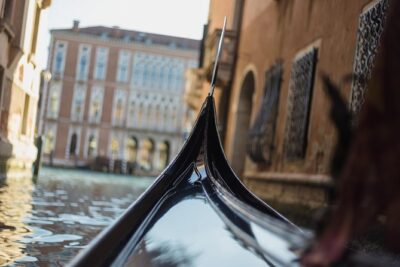
Venice’s Best: Basilica, Doge’s Palace, Gondola & History Gallery
Read our review →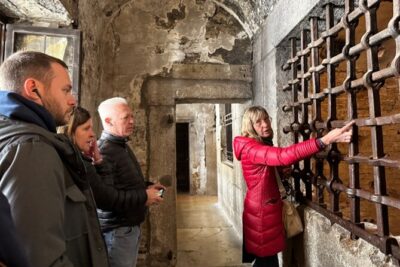
Best Of Venice: Saint Mark’s Basilica, Doges Palace with Guide and Gondola Ride
Read our review →
St Mark’s, Doge’s Palace, with Murano and Burano & Gondola Ride
Read our review →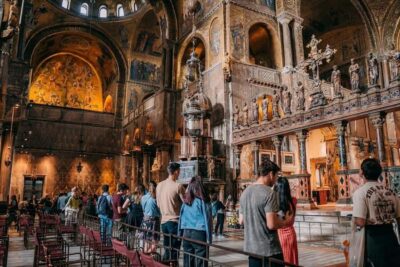
St. Mark’s Basilica Tour with Priority Entrance + Gondola
Read our review →
St. Mark’s Basilica Guided Tour with Venice Canals Gondola Ride
Read our review →
Welcome to Venice Group Tour St. Mark’s Basilica & Gondola Ride
Read our review →
Where this ride is listed